

Japan’s Immigration Policy Is at a Clear Turning Point
In recent years, the Japanese government has been shifting its approach to accepting foreign residents from a focus on quantity to an emphasis on quality.
At the core of this shift lies a redesign of the requirements related to residence status, permanent residency, and the acquisition of nationality.
What has become clear through media reports and statements by government officials is that future policy frameworks will place strong emphasis on the following:
Stricter management of residence status
Clearer requirements for permanent residency and nationality acquisition
Closer linkage with social security participation, tax compliance, and adherence to laws and regulations
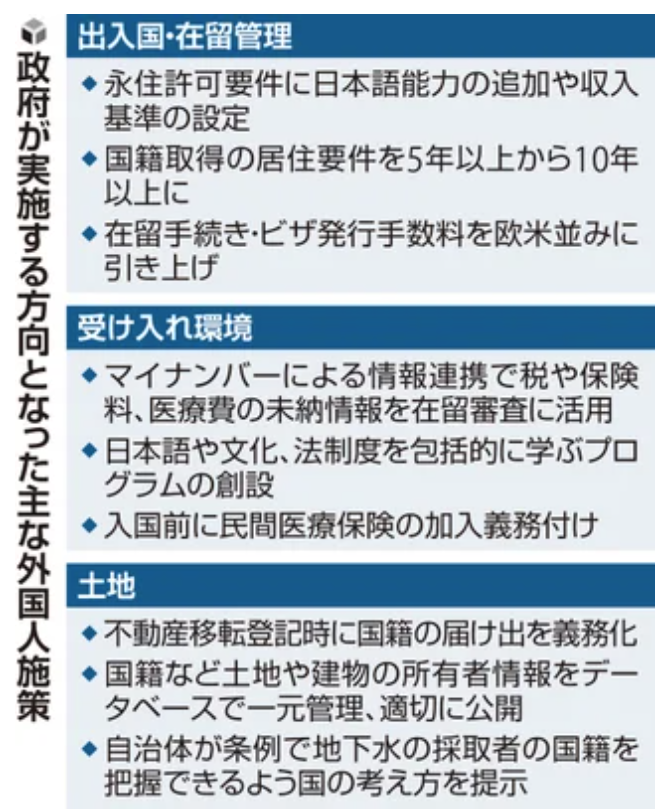
※Source:
Yomiuri Shimbun Online
“Draft of the Government’s Basic Policy on Immigration”
(Overview of Measures Related to Residence Management and Permanent Residency Requirements)
https://www.yomiuri.co.jp/politics/20251230-GYT1T00339/
Within this context, the fact that Japanese language proficiency is beginning to be positioned as an institutional requirement represents an especially significant development.
From an “Aspirational Goal” to an “Institutional Evaluation Criterion”
Until now, Japanese language proficiency has largely been treated as:
“An advantage if demonstrated”
“One of several reference factors”
However, under the government’s emerging policy direction, the review process for permanent residency applications is expected to place greater weight on factors such as:
The applicant’s ability to integrate and settle into Japanese society
The capacity to live independently and autonomously
The ability to understand and comply with public systems and legal frameworks
Japanese language proficiency is increasingly being incorporated as one of the objective indicators used to assess these elements.
This shift is not based on subjective impressions or general sentiment. Rather, it signifies that, from the perspective of institutional design, Japanese language proficiency is gradually becoming a formalized requirement.
The Institutional Meaning of Japanese Language Understanding in Permanent Residency
Permanent residency is not simply a “right to remain in Japan for a long time.”
It is a system designed to determine whether an individual is adequately prepared to continue living as a member of Japanese society over the long term.
Accordingly, the review process takes a comprehensive view of whether an applicant can:
Understand and comply with laws and legal systems
Comprehend notifications and explanations issued by administrative authorities
Make independent judgments and act responsibly
Within this framework, Japanese language proficiency serves as a highly rational and institutional indicator supporting these underlying conditions.
What Is Being Assessed Is Not Language Skill Alone
It is important to note that what the Japanese government seeks is not language ability in a narrow or technical sense.
What is truly being evaluated is whether an individual can:
Understand Japan’s institutional and legal systems
Fulfill the responsibilities expected of a long-term resident
Exercise independent judgment within society
Japanese language proficiency functions as the means through which these capacities are demonstrated.
In this sense, Japanese is increasingly becoming a foundational requirement that enables the permanent residency and long-term stay systems to function as intended.
Why Seikohsya Approaches Japanese Language Support Through a Policy Lens
At Seikohsya, we do not view Japanese language learning merely as a matter of
“improving language skills” or “preparing for examinations.”
Instead, we consider questions such as:
Which residence status is the individual aiming to obtain?Are permanent residency, entrepreneurship, or independent professional activity part of their long-term plan?
Which specific institutional requirements must be met?
Only by understanding the overall policy and institutional framework can Japanese language proficiency be appropriately positioned within an individual’s broader strategy.
Learning Japanese without understanding the relevant systems often leads to inefficiency and unnecessary detours.
Only Those Who Understand and Prepare for the System Retain Real Options
As immigration policy enters a period of transition, the assumption that
“things will probably work out if one proceeds as before”
is becoming increasingly untenable.
Within the future framework for permanent residency and long-term stay,
Japanese language proficiency will quietly—but steadily—serve as a factor that draws clear distinctions.
Seikohsya continuously monitors policy developments within the Japanese government and supports foreign residents in accurately understanding the requirements they face, enabling them to prepare in a balanced and appropriate manner—neither excessive nor insufficient.
🌸 成航舎(Seikohsya)
Unlock Human Potential with Seikohsya
📧 info@seikohsya.jp
| 🌐 seikohsya.jp